
Long before Athens or Rome was even founded, Crete dominated the Mediterranean Sea. The island was home to the Minoans whose art, writing system, and architectural skills are still admirable to these very days.
Crete in my mind is a fascinating island full of mythologies. It is said that Zeus, the Immortal King of Heaven and Earth, was born there, in a sacred cave full of bees. The rugged yet beautiful landscape was also the final destination of Europa, a princess of Phoenicia, who crossed the ocean on the back of a white bull that is Zeus in disguise. And there was Talos, a monstrous android that would sack any ship that drew near the island by hurling rocks at it. Even Homer mentioned Crete in the Odyssey as a fertile, hospitable stopover before the siege of Troy.
Europe’s first great civilization was the Minoan culture.
Nevertheless, the most popular myth to come out of Greece’s largest island is the legend of King Minos, and a fearsome monster called Minotaur. Mythology holds that the king built an elaborate labyrinth that no one could escape under his royal palace. Roaming in there was a man-eating creature with a massive human body and the head of a bull. Its skin was as tough as metal and had a dull yellow color like brass. Eventually, Minotaur was slain by Theseus who later became the King of Athens. The hero also managed to escape the labyrinth with a ball of thread provided by Ariadne, Minos’s daughter.
Minotaur and the Labyrinth might be fictitious, but there is undoubtedly a great civilization that existed on this island long before Athens or Rome was even founded. It’s named Minoan after its legendary ruler and flourished from around 3000 to 1100 B.C. Though their heydays are gone, traces of the Minoan culture can be admired today at the monumental palace of Knossos and within Crete’s impressive archeological museums.


1. Archaeological Museum of Heraklion
My journey to the very depths of European history began at the Heraklion Archaeological Museum – a two-story building located right at the heart of the city. Here, over 5500 years of Cretan history are on display, from Neolithic, and Hellenistic to the Roman period. However, the most captivating artifacts are inarguably those from the Minoan civilization.
The first floor is considered the world’s best place for Minoan art, as it houses by far the most complete and remarkable collection of frescoes excavated from Knossos. Probably influenced by Egyptian artisans, these masterpieces highlight Minoans’ everyday life, their fashion, and their favorite sport: bull-leaping. Interestingly, the murals were also applied to the decorative object as in the case of the Hagia Triada Sarcophagus dating to the late 1400 B.C. It’s unique because previously the Minoans only painted their palaces and houses, not funerary items.
The best museum for Minoan culture.
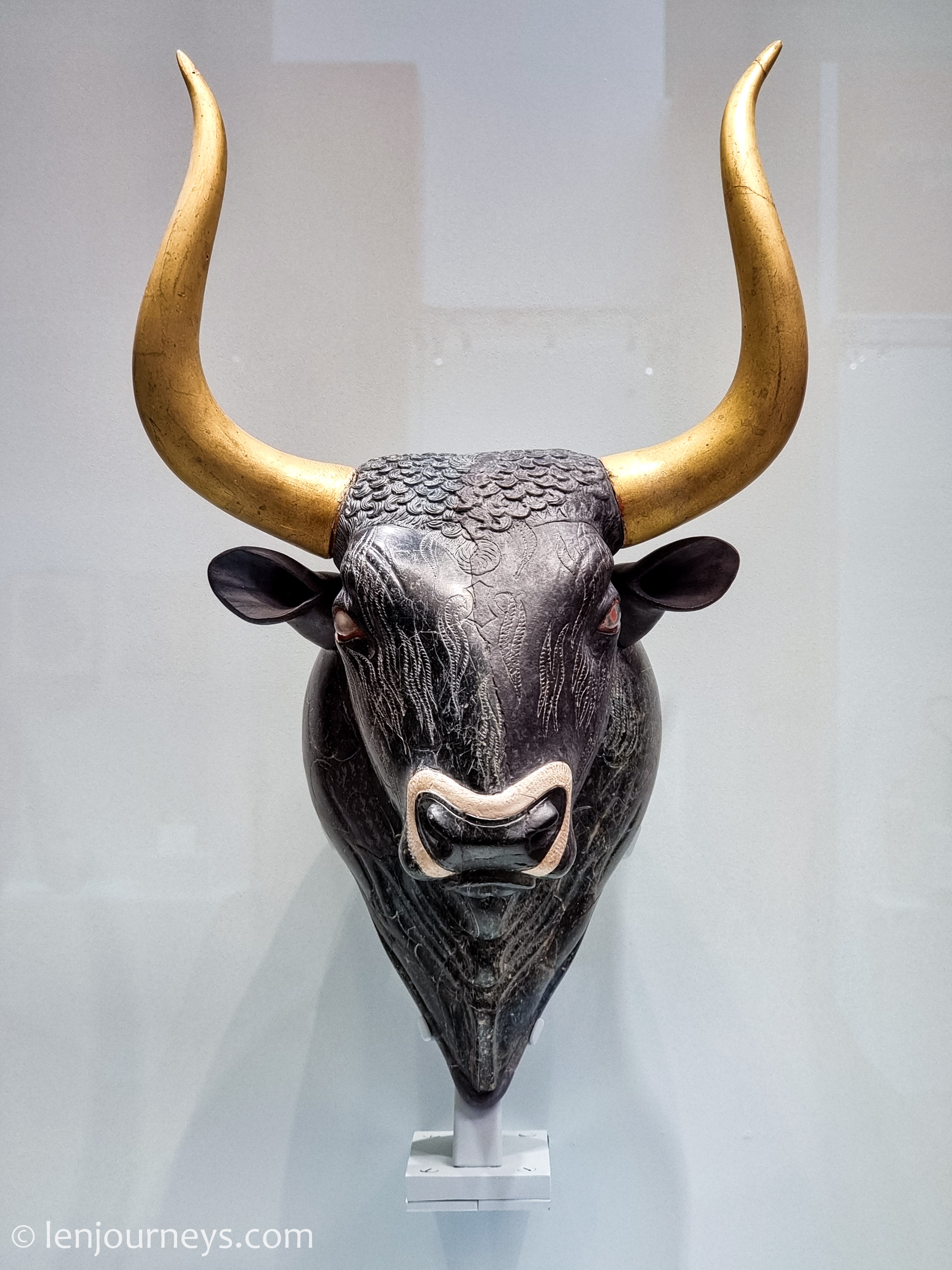
Meanwhile, products of daily use, such as clay pots, ceramicwares, and even gold jewelry can be found in the exhibition halls on the ground floor. They are so rich in detail, with vibrant colors and a wide array of motifs. Most represent nature, such as plants, marine life, and in particular the bull. My breath was taken away when I saw the magnificent Bull’s Head Rhyton (drinking vessel) delicately carved from black steatite. Its eyes are of jasper and rock-crystal, while the horns are elegantly gilded. Simply a wonderful example of Minoan artistry.


2. Knossos Palace
Approximately five kilometers south of the city center lies Knossos Palace, the zenith of Minoan culture for nearly two millenniums. It was first built during the Neolithic period, but the palace saw its greatest expansion under the Minoans. The site spreads over 43,000 m2 and contains not only a royal residence but also an administrative and religious center. Many workshops were also set up here where craftsmen produced goods for trading across the Mediterranean.
Knossos Palace was the zenith of Minoan culture for nearly two millenniums.
With over 1300 chambers, an equal number of stairs and passages, and numerous courtyards, it’s no surprise to see why people believed that Knossos was the labyrinth where the mighty Minotaur dwelled. Each room or probably house features strange, short columns with broad tops and narrow bases, as well as some pottery. A few were adorned with frescoes in vivid red and blue, reflecting the significance and wealth of its owners. The Minoans were also advanced for the time in terms of sanitation, building a water supply and drainage system that were not surpassed until thousands of years later.
Though Arthur Evans is often credited for unearthing Knossos and subsequently the Minoan civilization, Minos Kalokairinos – a Cretan businessman and scholar – was the first person to discover this site in 1877. The British archeologist only took the helm by the turn of the 20th century and undertook more extensive excavations. He also tried to restore the site, yet his work is highly controversial because of its inaccuracy regarding materials and style. However, the restoration lets us imagine the past and see what life was like inside the palace. While the Minotaur was nowhere in sight, I encountered a couple of charming peacocks. They gracefully wandered around the ruins as if they were the true rulers of Knossos.


Tips: As all original frescoes and artifacts are kept in the museum, it’s recommended to go there first before visiting Knossos. Those in the archeological site are merely insensible reconstructions made by Arthur Evan. Being said that the ruins of Knossos are worth visiting. You came here to admire the impressive scale, as well as the sophisticated layout of the Minoan’s grandest palace.
3. Archaeological Museum of Chania
Chania Archeological Museum – a cutting-edge triangular building that seems to emerge from a hillside – was the endpoint of my trip to the Minoan era. Opened in 2022, it is Crete’s newest attraction and is located in the suburb of Chalepa, a former aristocratic district during the Venetian times. A refreshing design, this sea-view museum contrasts nicely the old port town, which originated as a major Minoan settlement.
Within four exhibition halls (three on the ground and one on the first floor), 3600 artifacts such as pottery, sculptures, mosaics, and jewelry from both the city and the periphery of Chania are presented. They shed light on the private and public lives of people in West Crete throughout history, including the great Minoan civilizations.
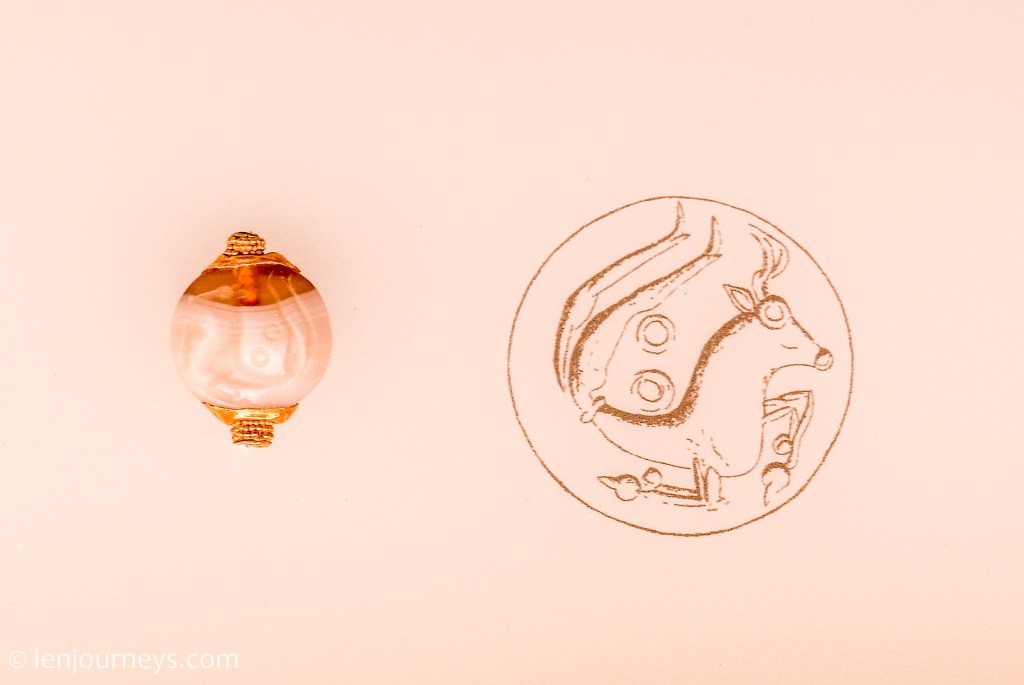
Highlights of this period include connecting vases, a clay bathtub, an incredible amount of bulls – a symbol of strength and fertility, and the reconstruction of an aristocratic house that was destroyed during the Great Earthquake in the year 365. However, the object that impressed me most was a splendid piece of pearl jewelry engraved with the Minotaur depiction.
The newest attraction in Crete.
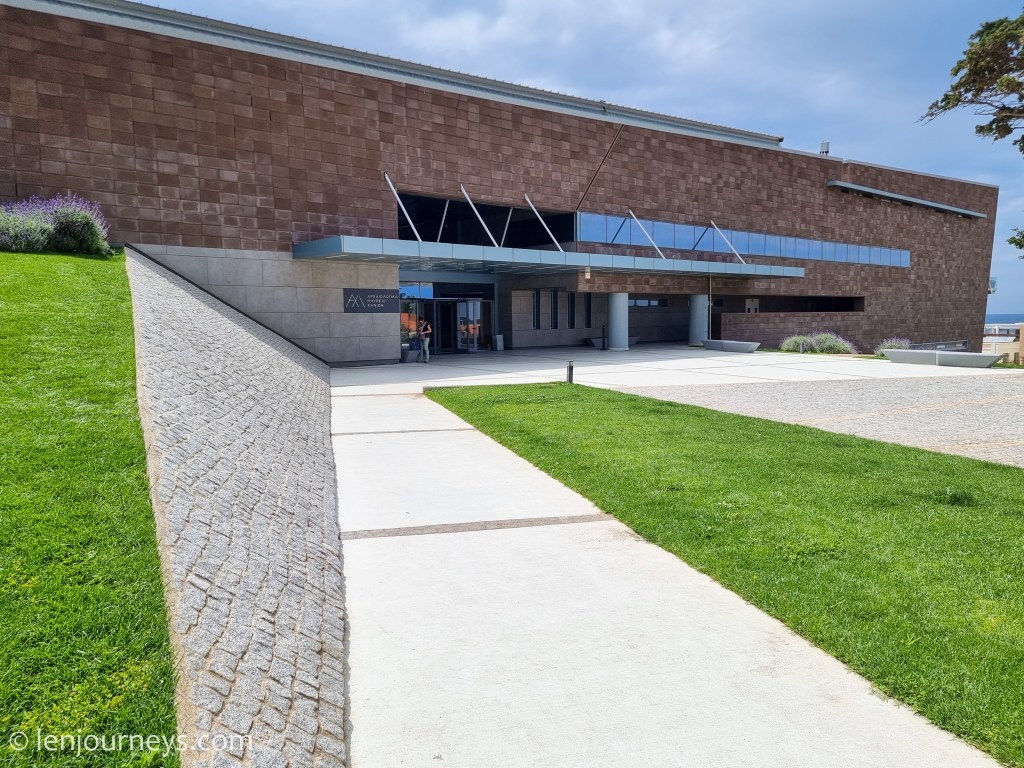


Tips: The Chania Archaeological Museum is located about three kilometers outside of the Venetian urban core. It takes approximately 30 minutes on foot. But it’s a scenic walk along the coast. Please note that some parts require walking uphill.


What a great description of this ancient Crete history of which I knew very little. Maggie
Same here. Before this trip, I thought that the first great civilization in the Mediterranean began somewhere on mainland Greece (Athens or Delphi). Never thought that Crete had such an advanced civilization thousands of years ago. Thank you for visiting, Maggie 😀
Your posts are always so amazing Len! Your photos are world class and your articles are so informative. Thanks for sharing! X
Your words made my day, Anna! Thank you 😀
You’re most welcome!
I’ve always wanted to visit Greece. But if I could only visit a few parts of the country, Crete would definitely be one of them. I’ve been fascinated by the Minoan culture since I watched the opening ceremony of the Athens Olympic Games in 2004. It’s amazing to think that this civilization thrived 5,000 years ago!
Incredible, isn’t it! It’s hard to believe that the Minoans could achieve so many thousands of years ago. Honestly, those potteries look more beautiful than items in today’s shops 🙂
I always find myself in awe when visiting places such as these, different cradles of civilization. I’ve never been to Crete or Greece for that matter, but it’s so high on top of my list. For the beaches, the food but even more to visit places with such cultural and historical importance. Thanks for such an insightful article!
You are most welcome 🙂 It was incredible to see how developed the Minoans were. Some items are so sophisticated that I doubt we can make it today.
Oh I loved this Len. It took me right back to my own time on Crete. We didn’t get to the Chania Museum, but certainly went to the one in Heraklion, and to Knossos, which was a huge highlight for me. Thanks for reminding me of how fabulous it is.
Alison
My pleasure, Alison! I love the artifacts in the Heraklion Museum. Such an extensive collection. But somehow I missed the Phaistos Disc 😛
This is such an informative write up, Len. It also looked like a trip rich in history about Crete in the ancient days. The Bull Head Rhyton is magnificent, and it really does look like a magnificent piece of artistry. That is lovely you also got to see Crete’s latest attraction, and it really does look like it houses a variety of artifacts made intentionally and carrying much historical symbolism. Great photos all round. Thank you for sharing. Wishing you a wonderful year ahead 😊
An excellent post with amazing photos! I’m happy to see that Minos Kalokairinos was mentioned. Often, Arthur Evans overshadows the fact that Minos is the one who initially discovered Knossos. It’s wonderful that you got to experience Knossos up close as well as the museums. Actually getting to see the ruins, art, etc. is such a profound experience that I’ll never forget.
Thank you, Ravyn! It’s ignorant not to mention Minos Kalokairinos. He was a Cretan so he must know his island better than a British explorer.
The ruin was beyond my expectations: vast and complex with all those rooms and stairs. But I don’t like that some guides misinterpreted the reconstructed parts as “original palace”. The Minoans would be baffled if they saw such awkward structures 🙂
One of the best article
I’m glad to hear that. Thanks for the kind words, Nana 🙂
Fascinating history of Crete, which I visited over 30 years ago and plan on returning next year. Great post!
Many thanks! Crete is a great place to come back. It’s a big island, and I love the Cretan food. For some reason, it suits me better than those in Athens 🙂